Asier García spent ten years running operations of up to 1,200 people with tools that were not up to the task. Then he built the ones he needed. Thirteen years later, PLANNAM launches a new website and a self-diagnosis tool that allows any executive to understand, without intermediaries, how much disorder is costing them.
There is a kind of learning that only happens from the inside. The kind that stays in the body after managing more than forty locations, more than twelve hundred people, and a EUR 500 million P&L with the tools at hand, which were almost never the tools you actually needed.
Asier spent ten years as operations director at a major company in the leisure sector. He began managing family entertainment centres, built from scratch a business line that went from zero to one hundred and twenty locations in four years, and ended up leading a national network of establishments across Spain. He trained in Industrial Engineering while working from a very young age in real operational environments. Perhaps that is why he stopped defining himself by a specific degree long ago and prefers to talk about systems, operations, and decisions. On LinkedIn he appears as an “Operational Intelligence Architect.” A title he invented because none of the existing ones quite fit.
“I don’t code,” he says with the ease of someone who has accepted that he does not need to. “I design systems.“
The problem no one had solved
In 2012, he left that company and founded PLANNAM. Not because he saw a market opportunity in the way investors use the term, but because he had lived the problem from the side where it hurts: the side of the person who has to decide how to cover a night shift in Zaragoza while managing a sick leave in Seville and a different collective agreement in every province.
That practical knowledge was not his alone. Over time, he brought together professionals who had lived similar problems from different areas – operations, technology, planning, and business leadership – to form the team that would develop PLANNAM over the following years.
Recording is not deciding
The question PLANNAM tries to answer is not how to record employee clock-ins, nor how to store contracts in a database. It is how an organisation makes decisions about its largest cost – people – in a way that is anticipatory, structured, and measurable. And why most organisations are still doing it reactively.
“The problem was not a lack of digitalisation,” Asier explains. “Many companies already had tools. The problem was that they had digitised the wrong part. They had time tracking, employee portals, clock-in apps. But the important decisions were still being made with Excel and the judgement of whichever manager happened to be on duty.“
This distinction – between recording what happens and deciding what should happen – is the core of what PLANNAM has been building for thirteen years. It is also what makes this Castelldefels-based company difficult to categorise within the workforce management market. It is not exactly a human resources management system. Nor is it a conventional planning tool. In the terminology Asier uses quite insistently, it is a labour decision infrastructure.
The GOFIT case illustrates better than any argument what that means in practice. The sports-centre chain operated in more than twenty locations across three countries with decentralised management, heavily dependent on each manager and with no global visibility over the operation. Shifts were assigned manually, the real demand of each centre never fully translated into concrete staffing needs, and scaling the network meant scaling administrative complexity as well – and that complexity was growing faster than the business.
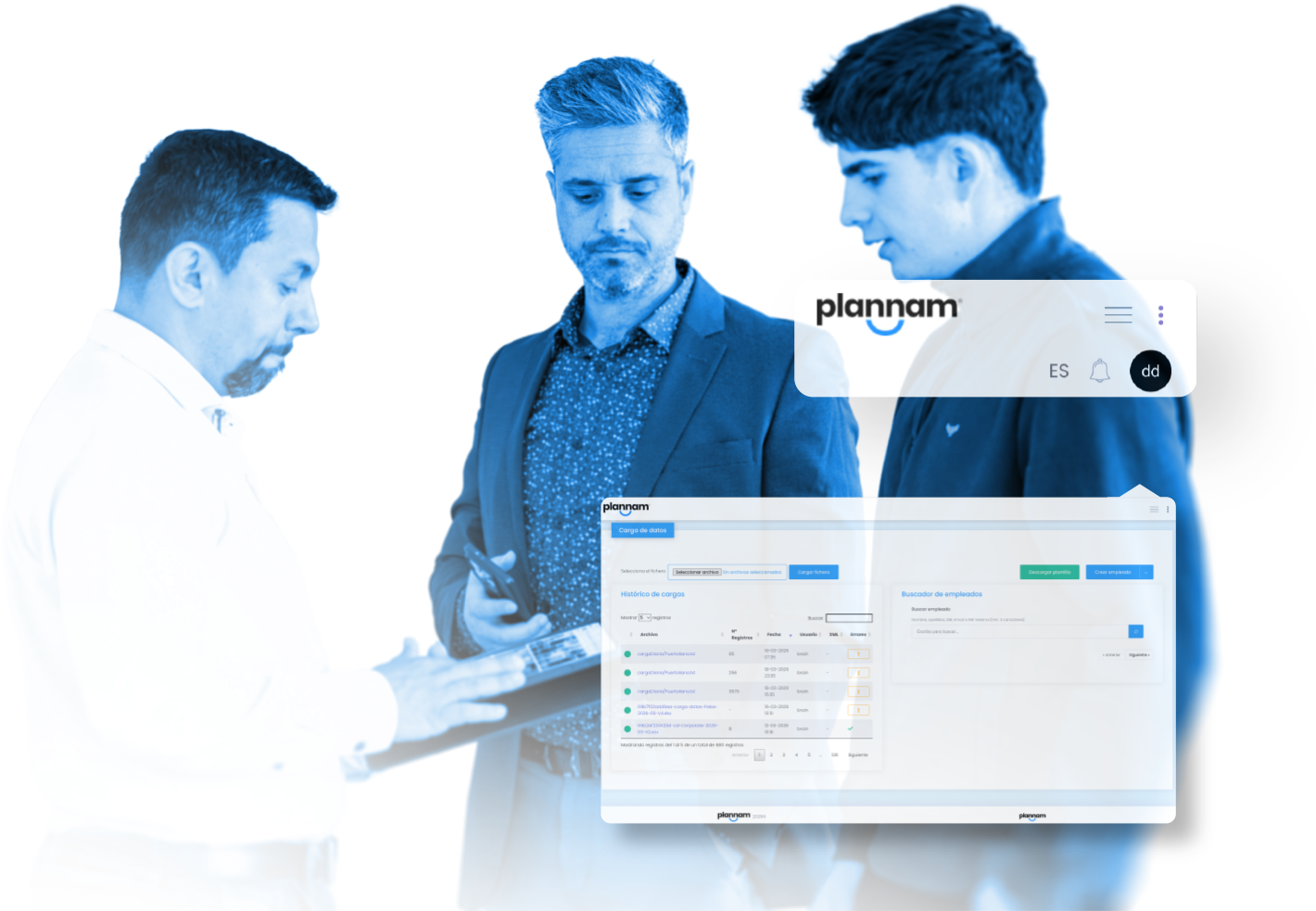
When they deployed PLANNAM as the central system, the entire labour cycle began running from a single environment: automatic planning, incident management, time tracking, and payroll export, connected in real time with the class CRM and the group’s HR systems. The result was a four-percentage-point reduction in the labour cost ratio, with estimated annual structural savings of between EUR 1.2 million and EUR 3.4 million and returns of between ten and twenty-eight times the investment. What matters most for understanding the model is this: GOFIT was able to keep growing without increasing its operating structure. The organisation scaled; the burden of managing it did not.
Fertiberia and Novartis represent two different sides of the same problem. The Spanish chemical company went from managing its daily operation with decentralised spreadsheets across plants to having full traceability and real-time visibility, without having to change its existing planning model. Novartis, with regulatory requirements that leave no room for error, found in PLANNAM a way to ensure that the right person is always on the right shift – not by intuition, but by system design.
Give before asking
PLANNAM has now renewed its corporate website and published, alongside it, something that did not exist in the sector: an open-access self-diagnosis tool that allows any executive to assess, in under ten minutes and without speaking to a salesperson, their organisation’s level of maturity in workforce management. The result is a report with an estimate of potential savings based on McKinsey research on workforce management systems, calibrated to the company’s specific profile.
“We wanted someone to arrive at a first conversation with their own data, not assumptions,” Asier explains. “To be able to say: I have completed the diagnosis and this is where I stand. And from there, if they want to, we talk.“
The tool was his idea and was developed by PLANNAM’s technical team. At a time when Artificial Intelligence promises to automate any sales qualification process, Asier has chosen something older and, apparently, more effective: give before asking. Offer judgement before asking for attention.
The new website reflects the same principle. It has stopped being a corporate presentation and has become a resource for industry professionals: in-depth articles, trend analysis, documented cases, and the self-diagnosis as a natural entry point. The platform also includes PLANNAM Micros, the version of the system designed for smaller companies operating with the same structural complexity but at a smaller scale.
A new category
The workforce management market has been growing for years, driven by regulatory pressure, the complexity of collective bargaining agreements, and the need to control a cost that in many sectors represents between forty and sixty percent of the structure. But what is happening now is qualitatively different. The convergence of planning, operations, legal compliance, and economic analysis under the same decision layer is not an incremental improvement of traditional WFM. It is a new category. The one Asier has been building for thirteen years before there was even a name for it, and which is now beginning to be recognised for what it is: operational intelligence applied to decisions about people.
The organisations that understand this first will have an advantage that is not easy to reverse. Not because they have implemented a better tool, but because they will have changed the level from which they make labour decisions. From reactive management to anticipatory decision-making. From the manager’s judgement to a system that structures it and makes it auditable.
“When I started, the question people asked was: do you have a clock-in system? Now the question is: how does your organisation make decisions about people? That is a complete category shift.“
And the category, says Asier with the calm of someone who has spent years being the only person in the room who knew what he was talking about, has only just begun.